
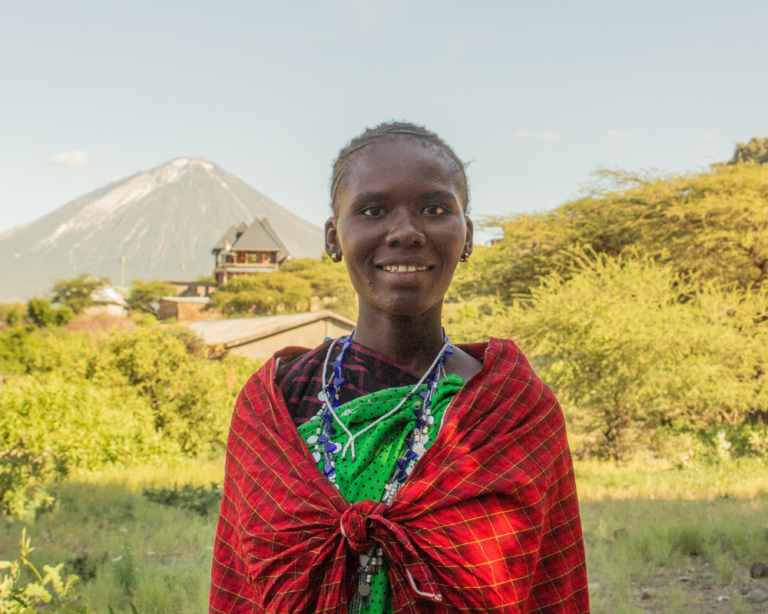
Negires Jeremia’s story reflects the transformative power of community-led healthcare. Living in Engaresero village in northern Tanzania, Negires has served as a Community Health Worker (CHW) since 2024. At just 26 years old, she is already a trusted health advocate, connecting pastoralist families with essential healthcare services.
Her journey demonstrates the importance of investing in young people, equipping them with knowledge, leadership, and practical skills so they can become agents of change within their own communities. But before receiving training through the Pastoral Women’s Council (PWC), her understanding of health, and her ability to help others, was very different.
Like many people in her Maasai community, Negires grew up surrounded by cultural beliefs and traditions that shaped how families approached healthcare. Many women gave birth at home, illnesses often went untreated, and people were reluctant to seek medical care. Language barriers, fear of being judged, and limited understanding of health services prevented many community members from visiting health facilities.
Everything began to change when PWC selected Negires to become a Community Health Worker. Through intensive training, she learned about maternal and child health, disease prevention, cervical and breast cancer awareness, disease outbreaks, hygiene, and community health education. More importantly, she gained the confidence to become a bridge between her community and the healthcare system. By investing in young leaders like Negires, PWC is helping create lasting change, empowering local youth with the knowledge and confidence to lead healthier, more resilient communities for generations to come.
“PWC provided me with training on community healthcare services, and since then, I have been working closely with nearby health facilities and I support mothers and children in my community”
Today, Negires’ role extends far beyond providing health education. She visits households, raises awareness about disease prevention, encourages mothers to attend antenatal care and deliver safely at health facilities, promotes childhood vaccinations, and reports health concerns directly to nearby clinics. She also works closely with doctors and nurses, ensuring healthcare services reach even the most remote Maasai homesteads.
One of the greatest barriers to healthcare in her community is fear and misinformation. Many community members, particularly women, hesitate to visit health facilities because they fear they will not be understood or respected due to language and cultural differences. As someone from the community, Negires has become a trusted first point of contact. People confide in her because she speaks their language, understands their traditions, and can explain health information in ways that are culturally familiar and easy to understand.
Community Health Workers like Negires play a vital role in bridging traditional knowledge and modern healthcare. Their work is not about replacing culture, but about helping communities distinguish between traditions that protect health and misconceptions that may unintentionally place women and children at risk. By combining scientific knowledge with cultural understanding, they help families make informed decisions while preserving the trust and identity of their communities.
One experience, in particular, reinforced the importance of Negires’ role as a Community Health Worker. A woman in her community went into labour but refused to go to the health facility because of a deeply rooted cultural belief. She feared that if her baby was born covered in vernix caseosa, a natural protective coating found on many newborns, healthcare workers would judge her for having had sexual intercourse late in pregnancy. Although vernix caseosa is a completely normal part of childbirth, this long-held misconception has discouraged some women in the community from seeking skilled medical care during delivery.
Thanks to her training, Negires was able to reassure the woman that these fears were unfounded. The labour progressed too quickly for them to reach the hospital, but Negires remained calm and applied what she had learned.
Without medical gloves, she carefully protected her hands with a clean cloth to reduce the risk of infection while assisting with the birth. Afterwards, despite some community members believing there was no need, she insisted that both mother and baby be taken to the health facility for examination and postnatal care.
“I explained to her: What you are worried about is not something dirty, it’s normal and natural for a baby to be born with bodily fluids, it’s just oil, it does not mean the woman has done anything wrong and even a woman who has not recently been with her husband can experience the same thing during labour“
Today, Negires has witnessed remarkable changes throughout her community. More women are attending health facilities during pregnancy, more children receive vaccinations, and families are increasingly seeking medical advice before illnesses become severe. Government healthcare workers also rely on Community Health Workers like Negires to reach remote Maasai homesteads that would otherwise be difficult to access. Together, they are bringing healthcare, education, and trust directly to the communities that need them most.
Negires’ story is about far more than becoming a Community Health Worker. It is about empowering young leaders to strengthen their own communities, building trust where fear once existed, and replacing harmful misconceptions with knowledge while respecting the traditions and identity of the Maasai people. Her work shows that meaningful change happens when education is delivered by trusted community members who understand both the science and the culture.
Today, she is helping build a future where healthcare is more accessible, mothers give birth more safely, communities are better informed, and trust between pastoralist families and healthcare providers continues to grow, one household at a time.