
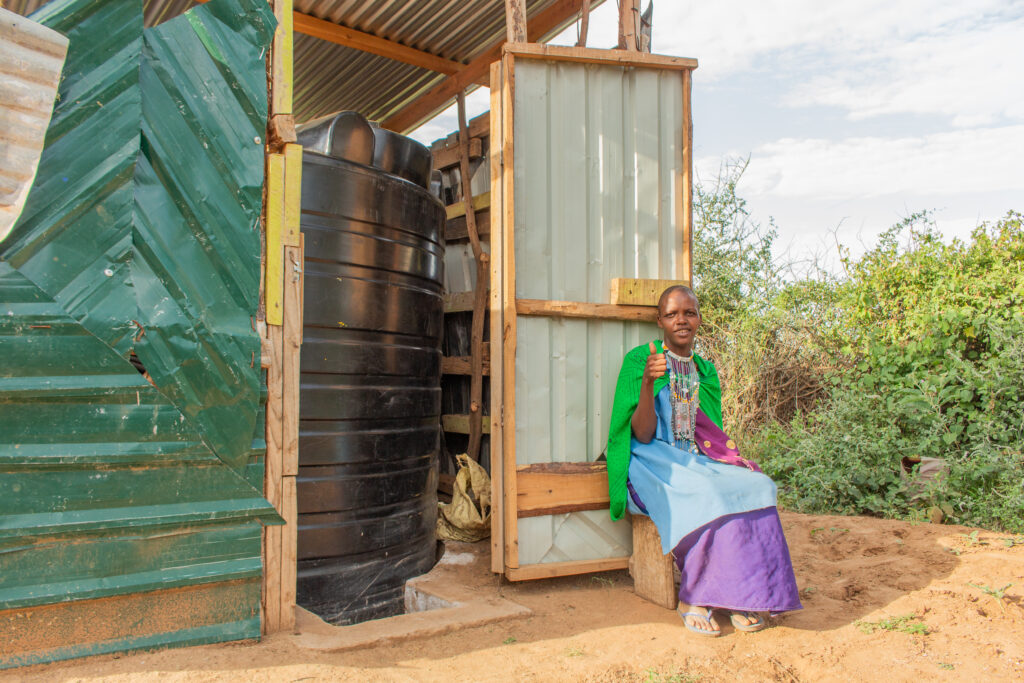
Nageli Shinini’s story is a powerful example of how access to knowledge, resources, and climate-smart solutions can transform everyday life for Indigenous pastoralist and agro-pastoralist families. Living in a rural village in Longido District, where water scarcity had long shaped the rhythm of daily life for generations, Nageli experienced firsthand the heavy burden that limited water access places on women, girls, families, and livelihoods.
Before receiving support through PWC’s climate resilience initiatives, life was defined by long and exhausting journeys in search of water. Every morning, Nageli and other women in her village walked long distances to fetch water. Due to the weight they could carry, they were only able to transport one container per trip, often requiring multiple journeys to collect enough water for their families. This burden also affected girls, who were sometimes forced to miss school to help with water collection.
The nearest water source was a dam shared by both people and livestock, located 15 kilometers away, exposing families to increased risks of waterborne diseases while making access to safe water a daily struggle.
“There is hunger because if water is difficult to access, it’s impossible for families to cook.
You leave in the morning and return in the evening, to find your children
suffering from hunger because the water is very far”
For Nageli and many women in her village, water scarcity affected every aspect of life.
The time spent searching for water meant less time available for childcare, household responsibilities, and income-generating activities.
“Water scarcity made it difficult for us to travel or start any business activities because,
we had to go and fetch water before doing other activities, which consumed a lot of time”
But everything began to change when Nageli participated in a climate-smart livelihood training, where she learned about the importance of water conservation, and sustainable resource management. Through PWC’s support, she received a 10,000-liter water storage tank and a rain water harvesting system.
The training gave Nageli more than just access to water, it transformed the way she viewed water management. She learned that water could become a foundation for household resilience, supporting not only health and hygiene but also food production, environmental restoration, and long-term adaptation to climate change.
Combining this new knowledge with lessons from a tree-planting initiative, Nageli took additional steps to protect and maximize the benefits of her water system. She fenced her water tank, creating a protective structure around it to prevent damage from animals, reduce misuse and maintain water quality. Inspired by the opportunities created through rainwater harvesting, Nageli further strengthened her household’s water security by purchasing additional 1,000-liter storage tanks placed across different areas of her boma.
Today, she has three additional tanks connected to three additional rainwater harvesting systems, allowing her to better manage water for cooking, washing, and other daily activities. She plans to continue expanding her water storage capacity in the future.
Beyond meeting her family’s immediate needs, Nageli has also used harvested water to support environmental and livelihood activities. She waters the trees she planted around her home and maintains a kitchen garden, creating additional sources of food.
“It has greatly benefited me because I no longer struggle waiting for rain,
and I am able to support my neighbors who are still suffering”
Nageli’s transformation has extended beyond her own household.
She shares water with neighbors who continue to face challenges accessing reliable water sources and actively encourages other community members to invest in rainwater harvesting systems. Through her actions, she has become an example of how individuals can create solutions that benefit entire communities.
The impact of improved water access has been profound. Families that once struggled to prepare meals because water was unavailable now experience greater stability. Women who once spent entire days walking in search of water now have more time to focus on their families, livelihoods, and business activities.
Nageli’s story is about far more than a water tank. It is about dignity, resilience, and the power of equipping communities with the tools needed to adapt to a changing climate.
Through PWC’s climate resilience initiatives, Nageli and many other women are becoming leaders in water management, environmental conservation, and community resilience.
Her journey is a reminder that when communities are trusted and supported with the right tools, even the greatest challenges can become opportunities for transformation.